
When a creative team first integrates generative tools, the initial phase is usually one of high-velocity experimentation. Individual designers discover they can produce a hero image in seconds rather than hours. However, as the production volume scales from five assets to five hundred, a structural problem emerges: style drift. Without a centralized architecture for visual logic, the output begins to look like a fragmented collection of “cool images” that lack a cohesive brand soul. One designer’s interpretation of “minimalist tech” might lean toward Brutalism, while another’s leans toward Corporate Memphis.
For content teams, the challenge isn’t the generation itself; it’s the operationalization of consistency. Moving from a prompt-based hobbyist mindset to a production-ready pipeline requires more than just a shared login. It requires a standardized stack where models like Banana AI are utilized not just for their raw power, but for their ability to be constrained within a team’s specific aesthetic guardrails.
The Style Drift Problem in Collaborative Generative Workflows
In a traditional design workflow, consistency is maintained through a brand book—a static document of hex codes, font weights, and grid systems. In generative workflows, those rules are replaced by latent space variables. When team members work in silos, they often develop their own “prompting dialects.” One person might favor long, descriptive natural language, while another uses shorthand technical tokens.
This decentralized approach leads to a fragmented aesthetic. Even if the subject matter remains the same, the lighting, texture, and “vibe” shift because the underlying model interpretation varies based on prompt structure. This dilution of brand equity is the primary friction point for teams moving from the testing phase to full-scale production. The cognitive load of maintaining this consistency manually is immense. Managers find themselves “fixing” AI output in Photoshop just to make disparate images look like they belong to the same campaign, which effectively negates the efficiency gains of using generative tools in the first place.
Standardizing the Stack: The Role of Nano Banana AI in Rapid Iteration
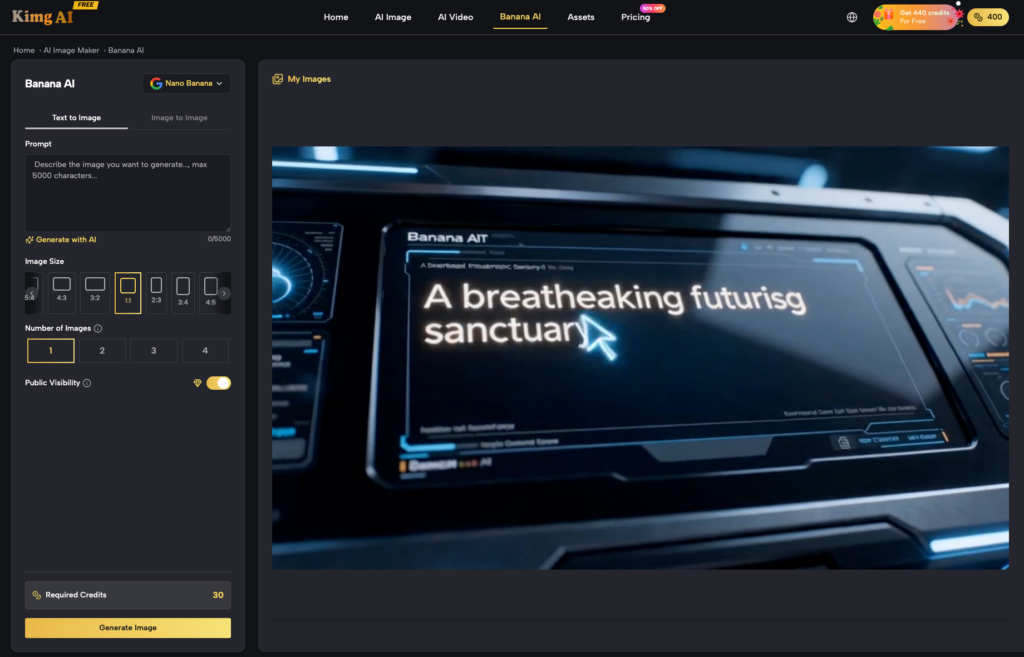
To solve style drift, teams must standardize the technical components of their stack. This often means selecting a primary model for high-velocity tasks that balances speed with fidelity. Nano Banana AI has emerged as a functional baseline for many teams because it handles the “K-level” detail required for modern social platforms without the extreme latency of larger, more cumbersome models.
By using a unified platform like Kimg AI, teams can establish a “Source of Truth.” Instead of hopping between various local installs or different cloud providers, a team can lock in their settings. This includes fixed aspect ratios, specific seed ranges (where applicable), and a shared prompt library. The goal is to minimize the variables. If every team member is starting from the same architectural foundation provided by Nano Banana AI, the “delta” between their results decreases significantly. This isn’t about stifling creativity; it’s about ensuring that the creative energy is spent on the concept rather than fighting the tool to stay “on-brand.”
Operationalizing Reference-Based Generation
One of the most significant shifts in professional AI production is the move away from text-to-image toward reference-based generation. For a brand, text-only prompting is often too unpredictable. You might ask for a “blue armchair in a sunlit room” and get ten different shades of blue and five different furniture styles.
This is where the Nano Banana model proves its worth in an image-to-image workflow. By providing a reference image—whether it’s a sketch, a 3D block-out, or an existing brand asset—teams can maintain the composition and color palette across a series. Instead of describing a specific lighting setup, the designer “shows” it to the model.
Operationalizing this involves:
- Image-to-Image Transformations: Using a base brand asset and asking the model to vary the environment while keeping the core subject consistent.
- Inpainting and Outpainting: Rather than regenerating an entire image when a small detail is wrong, teams use surgical tools to modify specific areas. This preserves the parts of the image that are already brand-compliant.
- Style Fusion: Blending the aesthetic of a successful previous generation into a new prompt to ensure continuity.
Using Banana AI for these specific, controlled transformations allows teams to move from a “lottery” mindset—where they hope for a good result—to a “sculpting” mindset, where they refine an asset until it meets a specific art direction.
Scaling Without Sacrificing: The Upscaling and Refinement Loop
A common mistake in team workflows is delivering raw AI output. Even high-quality models produce artifacts or “noise” that becomes apparent when viewed on high-resolution displays. To ensure that AI assets don’t look “low-rent,” a post-generation refinement loop is mandatory.
This loop typically starts with high-resolution upscaling. While many models generate at a base 512×512 or 768×768, professional output requires 1024×1024 (1K) or higher. Pushing an image to “K-level” resolution isn’t just about size; it’s about the reconstruction of details that may have been muddy in the initial generation.
Once an image is upscaled, it should pass through a “Quality Gate.” This is a human-led step where a creative lead or senior designer verifies that the output from Banana AI matches the original art direction. This is where “AI fatigue” is often prevented. By adding a human layer of critique, teams can catch those “uncanny valley” moments—such as distorted hands or inconsistent lighting—that a machine might overlook but a customer will certainly notice.
Navigating the Uncertainties of Generative Production
It is important to reset expectations regarding what these tools can currently do at a team scale. Despite the rapid progress in generative media, there are hard limitations that every creative lead must account for.
First, the current state of the technology makes 100% character or object persistence extremely difficult without advanced external training (like LoRAs) or very rigid seed management. If your campaign requires the exact same person to appear in twenty different scenarios, be prepared for significant manual retouching or a high failure rate. The models are probabilistic, not deterministic.
Second, there is an inherent uncertainty in model weights and platform updates. A prompt that works perfectly today with Banana AI might yield slightly different results next month if the underlying model is tuned or updated. This is why archiving reference seeds and “golden prompts” (prompts known to produce high-quality, brand-safe results) is critical.
Finally, while text rendering in images has improved significantly, teams should still remain skeptical of relying on AI for typography or precise brand logos. The internal logic of how these models render text is still prone to hallucination. For professional assets, it is almost always better to generate the visual background and then overlay brand-accurate typography in a vector tool.
Building a Sustainable Feedback Loop for Content Teams
The transition from a manual workflow to an AI-augmented one changes the role of the designer. The job shifts from “maker” to “creative director.” Success in a team setting is defined by how well the group can learn from its collective failures.
Establishing a post-mortem process for “failed” generations is as important as celebrating the successes. If a specific prompt consistently produces off-brand colors, that information needs to be fed back into the team’s internal prompting guide. Over time, this guide becomes a “living brand book” for the generative era.
Ultimately, visual consistency isn’t a byproduct of the software you choose; it is a result of the operational constraints you place upon it. By standardizing on a reliable model like Nano Banana, moving toward reference-based workflows, and acknowledging the current limitations of the medium, content teams can scale their output without losing their identity. The goal is to build a pipeline that is predictable, repeatable, and above all, indistinguishable from professional human art direction.